업데이트된 원본은 www.astronomynotes.com 에서 볼 수 있습니다.
The more mass there is, the more gravity there is to slow down the expansion. Is there enough gravity to halt the expansion and recollapse the universe or not? If there is enough matter (gravity) to recollapse the universe, the universe is ``closed''. In the examples of curved space above, a closed universe would be shaped like a four-dimensional sphere (finite, but unbounded). Space curves back on itself and time has a beginning and an end. If there is not enough matter, the universe will keep expanding forever. Such a universe is ``open''. In the examples of curved space, an open universe would be shaped like a four-dimensional saddle (infinite and unbounded). Space curves away from itself and time has no end.

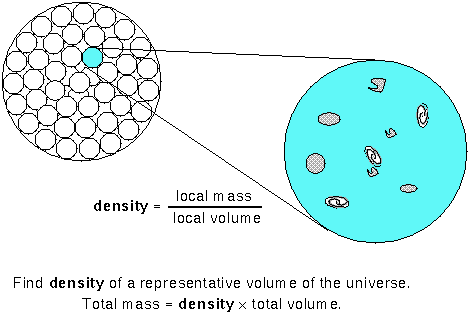
Instead of trying to add up all of the mass in the universe, a more reasonable thing to do is to find the density of a representative region of the universe. The density = (mass in the region)/(volume of the region). If the region is truly representative, then the total mass of the universe = the density × the total volume of the universe. If the density is great enough, then the universe is closed. If the density is low enough, then the universe is open. In the popular astronomy magazines, you will probably see the mass density of the universe specified by the symbol ``W''. It is the ratio of the current density to the ``critical density'' described in the next paragraph. If W < 1, the universe is open; if W > 1, the universe is closed.