
업데이트된 원본은 www.astronomynotes.com 에서 볼 수 있습니다.
Einstein's equation E = mc2 says that mass can be converted to energy and vice versa. If you extrapolate the expansion rate and temperature of the universe back to much closer to the Big Bang than when the cosmic microwave background was produced, you find that within the first few seconds, the energy of the photons was great enough to create particles like electrons and protons. But along with the ordinary particles, the photons also created the antimatter counterparts to the particles, e.g., anti-electrons (called positrons) and anti-protons. Antimatter is briefly discussed in the context of nuclear fusion and the neutrino sections of another chapter.
The antimatter counterpart of an ordinary particle has the same mass and opposite charge of the ordinary particle (if it is not neutral). When an ordinary particle and its antimatter counterpart collide, they completely annihilate each other to create photons. The process can be reversed if the photons have enough energy (i.e., are high-energy gamma ray photons). Within the first microsecond (10-6 second), the universe was hot enough for the photon radiation to undergo this matter-antimatter particle transformation using massive particles like protons and neutrons. When the temperature dropped to about 1013 K at one microsecond after the Big Bang, this process stopped for the protons but it continued for the less massive particles like the electrons. Neutrons were not created in the energy-matter conversion process but some were created when protons and electrons fused together.
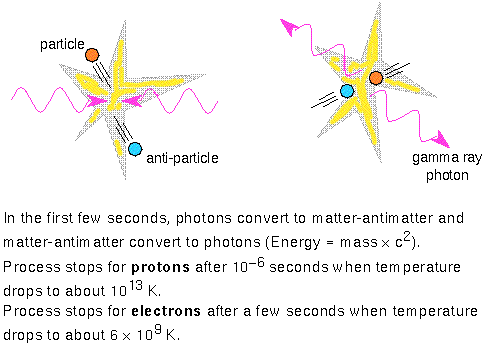
When the universe had expanded for another few seconds, it cooled to a temperature of ``only'' 6 × 10⁹ K and the electron-positron production and annihilation process ceased. This is also the time when the number of neutrons stopped increasing from the proton-electron fusion process. The number of neutrons was fixed at a ratio of 1 neutron for every 5 protons. For reasons not completely understood, there was a very slight excess of ordinary matter over antimatter (by about 1 part in 109). This is why there was still some ordinary matter left over when all the antimatter had been annihilated. (This must be the case, otherwise you wouldn't be here!) All of the protons, neutrons, and electrons in matter today were created in the first few seconds after the Big Bang.