
업데이트된 원본은 www.astronomynotes.com 에서 볼 수 있습니다.
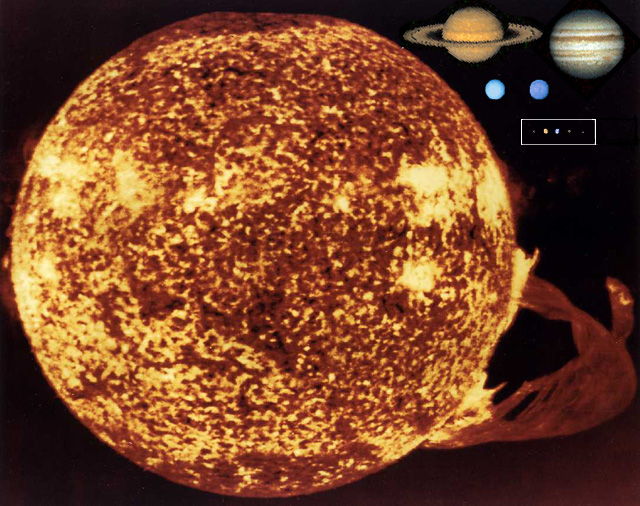
크기
태양은 태양계에서 가장 큰 것이다. 그것의 각크기가 0.5°인 것으로부터 지구에서 태양까지의 거리는 무려 150×106km정도이고, 그 직경은 1,392,000 km임을 알 수 있었다. 이는 지구 직경의 109배에 해당하는 길이이고 가장 큰 행성인 목성보다는 거의 10나 큼을 말한다. 이러한 태양의 거대한 중력에 이끌려 모든 행성들은 태양 주위를 공전하고 있는 것이다. 태양의 질량은 지구의 333,000 배이고 목성보다는 1000배 이상 무겁다. 이렇게 엄청난 질량을 가지고 있기에 태양은 스스로 빛을 내는 항성-별-인 것이다. 이것이 별을 행성과 구분짓는 잣대이다.구성
태양은 무엇으로 구성되어 있을까? 분광학으로 우리는 태양이 94%의 수소와 6%정도의 헬륨 그리고 0.13%(그 중 산소, 탄소, 질소가 0.11%에 해당)의 여러가지 원소로 이루어진 것을 알아내었다. 천문학에서는 헬륨보다 조금이라도 더 무거운 원자는 모두 "금속 원자"라고 부른다. 태양은 또한 네온, 나트륨, 마그네슘, 알루미늄, 규소, 인, 황, 칼륨, 철등을 함유하고 있다. 여기에 인용한 각 원자의 퍼센트는 원자들의 상대적 수를 의미하는 것이다. 만일 질량으로 그 퍼센트를 매기면 수소는 태양 질량의 78.5%, 헬륨은 19.7%, 산소는 0.86%, 탄소는0.4%, 철은 0.14%, 그리고 나머지 원자들은 0.54%를 차지한다..태양의 내부
아래에 태양의 중심에서 바깥쪽을 이루고 있는 것을 순차적으로 설명하였다.핵
핵은 태양의 가장 중심에 있는 것으로 태양 전체 질량의 10%를 차지한다. 핵융합 반응으로 생성되는 에너지는 바로 이곳으로 부터 나온다. 핵의 바깥층들이 누르는 엄청난 중력으로 인해 핵은 매우 뜨겁고 밀도가 높다. 핵융합이 일어나려면 엄청난 열과 밀도가 필요하다. 태양의 핵은 약 16×106K의 온도와 물의 160배에 해당하는 밀도를 가진다. 이는 물의 7배의 밀도를 가지는 밀도가 큰 철의 20배가 넘는 수치이다. 그러나 태양의 내부는 엄청난 온도로 인해 항상 가스 상태이다. 지구에서 볼 수 있는 것과 같이 융해된 바위같은 것은 찾아볼 수 없다.복사층
복사층(radiative zone)이란 태양 내부 초고온에서 온도가 낮은 바깥층으로 에너지가 광자의 형태로 전달되는 곳을 말한다. 사실상 핵도 이에 포함된다. 복사층은 태양 반경 내부의 85% 정도까지를 말한다.대류층
태양 반경의 바깥 15%에 해당하는 층에서 에너지는 대류의 과정을 통해여 전달된다. 온도가 낮을수록 더 많은 이온은 광자의 외부 유출을 좀 더 효과적으로 차단할 수 있다. 따라서 대류층에서 일어나는 활동으로 매우 뜨거운 태양의 내부로부터 나오는 에너지는 온도가 낮은 공간으로 이동된다. 이 대류층(convection zone)은 태양 표면의 바로 아래에 있다.

태양의 표면
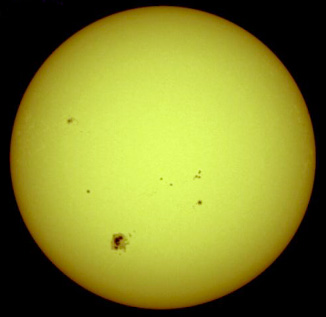 우리가 볼 수 있는 태야의 가장 깊은 층은 바로 광구(photosphere)이다. 이 "광구"란 의미는 "빛으로 된 구" 이며, 태양의 맨 위층에 있으므로 "태양 표면"으로 불리우며 광자가 마침네 우주 공간으로 빠져 나가는 곳이다. 광구의 두께는 약 500 km이다. 명심할 것은 태양은 분명 가스 덩어리이므로 그 표면에 우리가 설 수 있다거나 떠 다닐 수 있다고 생각해서는 안된다. 태양은 연속 스펙트럼을 방출한다. 온도 측정에 사용되는 여러 방법으로 광구의 온도가 대략적으로 5840 K임을 알 수 있다..
태양의 온도
One method, called Wien's law, uses the wavelength of the peak emission,λpeak, in the Sun's continuous spectrum. The temperature in Kelvin = 2.9 × 10⁶ nanometers/λpeak.
Another method uses the flux of energy reaching the Earth and the inverse square
law. Recall from the Stellar
Properties chapter that the flux is the amount of
energy passing through a unit area (e.g., 1 meter2) every second. From the
Inverse Square Law of Light Brightness, you find that the solar flux at
the Earth's distance = the Sun's surface flux × (Sun's radius/Earth's
distance)2 = 1380 Watts/meter2. Since
the Sun's photosphere is approximately a thermal radiator, the flux of energy at
its surface =  × (the Sun's surface temperature)4,
where is the
Stefan-Boltzmann constant. Rearranging the equation, the photosphere's
temperature = [(solar flux at Earth)/) ×
(Earth distance/Sun's radius)2]1/4.
× (the Sun's surface temperature)4,
where is the
Stefan-Boltzmann constant. Rearranging the equation, the photosphere's
temperature = [(solar flux at Earth)/) ×
(Earth distance/Sun's radius)2]1/4.
These two methods give a rough temperature for the Sun of about 5800 K. The upper layers of the photosphere are cooler and less dense than the deeper layters, so you see absorption lines in the solar spectrum. Which element absorption lines are present and their strength depends sensitively on the temperature. You can use the absorption line strengths as an accurate temperature probe to measure a temperature of about 5840 K.
Features on the Photosphere
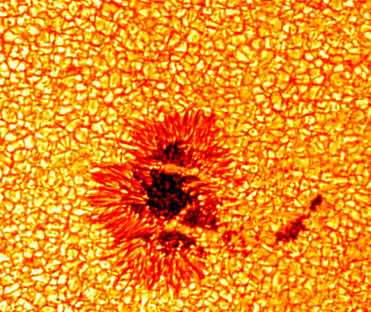
Sunspots + granulation in the photosphere (courtesy of Peter N. Brandt). There are also movies of the granulation available at his web site.
Galileo discovered that the Sun's surface is sprinkled with small dark regions called sunspots. Sunspots are cooler regions on the photosphere. Since they are 1000--1500 K cooler than the rest of the photosphere, they do not emit as much light and appear darker. They can last a few days to a few months. Galileo used the longer-lasting sunspots to map the rotation patterns of the Sun. Because the Sun is gaseous, not all parts of it rotate at the the same rate. The solar equator rotates once every 25 days, while regions at 30° above and below the equator take 26.5 days to rotate and regions at 60° from the equator take up to 30 days to rotate.
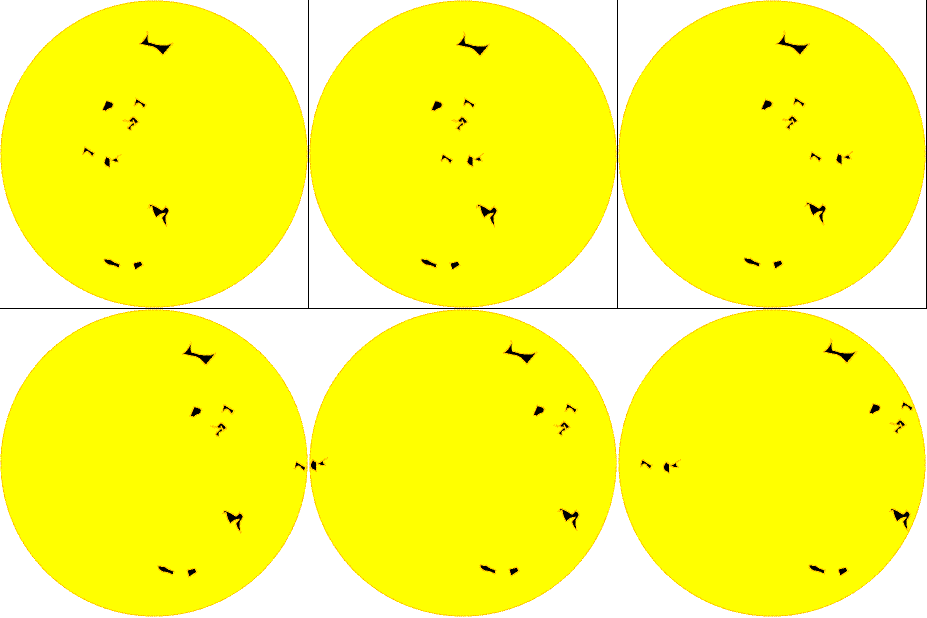
Animation begins with sunspots at different latitudes lined up. The sequence ends after one rotation of the equator---the sunspots near the poles have not appeared yet---and the animation starts over.
Hundreds of years of observing the sunspots on the Sun shows that the number of sunspots varies in a cycle with an average period of 11 years. At the start of a sunspot cycle the number of sunspots is at a minimum and most of them are at around 35° from the solar equator. At solar maximum when the sunspot number peaks about 5.5 years later, most of the sunspots are within just 5° of the solar equator.
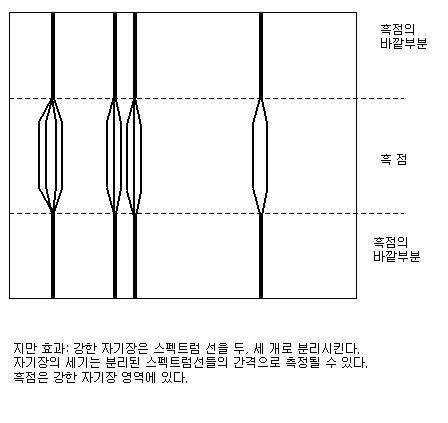
Sunspots are regions of strong magnetic fields. This affects the spectral lines in the sunspot spectra. Each absorption lines will split up into multiple components. The amount of separation between the components measures the strength of the magnetic field. The magnetic field is somehow responsible for the sunspot cycle. In one 11-year cycle the leading sunspot in a sunspot group will have a north magnetic pole while the trailing sunspot in the group will have a south magnetic pole. In the next 11-year cycle the poles will switch so the total cycle is 22 years long.
At solar maximum there are more prominences and solar flares. Prominences are bright clouds of gas forming above the sunspots that follow the magnetic field line loops. So-called ``quiet'' ones form in the corona (the Sun's atmosphere) about 40,000 kilometers above the surface. Sometimes they form loops of hydrogen gas as the gas follows the loops in the magnetic field. Quiet prominences last several days to several weeks. ``Surge'' prominences lasting up to a few hours shoot gas up to 300,000 kilometers above the photosphere.

The smallest of the loop prominences shown here is over three times bigger than the Earth (courtesy of National Solar Observatory/Sacramento Peak Observatory).
Solar flares are eruptions more powerful than surge prominences (a flare is shown in the Sun + planets montage above). They will last only a few minutes to a few hours. A lot of ionized material is ejected in a flare. Unlike the material in prominences, the solar flare material moves with enough energy to escape the Sun's gravity. When this burst of ions reaches the Earth, it interferes with radio communication. Sometimes a solar flare will cause voltage pulses or surges in power and telephone lines. Brownouts or blackouts may result. Humans travelling outside the protection of the Earth's magnetic field will need to have shielding from the powerful ions in a flare.
High resolution observations of the solar surface show a honeycomb pattern called granulation made of bright spots of convection 700 to 1000 kilometers across (see the picture above). Hot gas rises in the middle of each granule bringing energy from the interior to the surface and sinks back down on the border of a granule. The hot gas rising in the center is brighter than the cooler gas sinking at the borders. Each granule will last for about 8 minutes.
Solar Atmosphere
Moving outward from the core to the surface of the Sun, the temperature and density of the gas decreases. This trend in the density continues outward in the Sun's atmosphere. However, the temperature increases above the photosphere. The cause of the temperature increase is not known but a couple of popular theories invoke sonic waves or magnetic waves to heat the atmosphere.Chromosphere
During solar eclipses a thin pink layer can be seen at the edge of the dark Moon. This colorful layer is called the chromosphere (it means ``color sphere''). The chromosphere is only 2000 to 3000 kilometers thick. Its temperature rises outward away from the photosphere. Because it has a low density, you see emission lines of hydrogen (mostly at the red wavelength of 656.3 nanometers)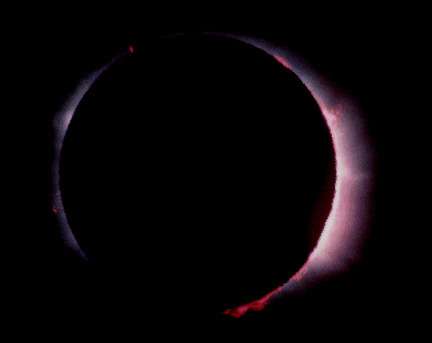
The thin chromosphere is visible in this solar eclipse picture.
Corona
When the new Moon covers up the photosphere during a total solar eclipse, you can see the pearly-white corona around the dark Moon. This is the rarefied upper atmosphere of the Sun. It has a very high temperature of one to two million Kelvin. Despite its high temperature, it has a low amount of heat because it is so tenuous.
Total solar eclipse in 1973 showing the corona (courtesy of Fred Espenak).
The corona is known to be very hot because it has ions with many electrons removed from the atoms. At high enough temperatures the atoms collide with each other with such energy to eject electrons. This process is called ionization. At very high temperatures, atoms like iron can have 9 to 13 electrons ejected. Nine-times ionized iron is only produced at temperatures of 1.3 million K and 13-times ionized iron means the temperature gets up to 2.3 million K! During strong solar activity, the temperature can reach 3.6 million K and lines from 14-times ionized calcium are seen.
Most of the corona is trapped close to Sun by loops of magnetic field lines. In X-rays, those regions appear bright. Some magnetic field lines do not loop back to the Sun and will appear dark in X-rays. These places are called ``coronal holes''.
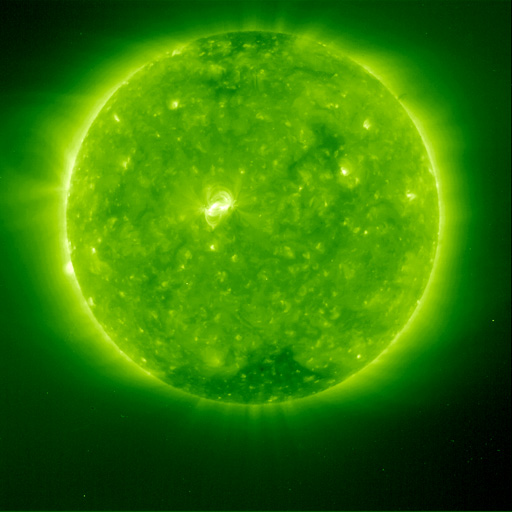
More details in the corona are seen when looking in the higher energy regions of the electromagnetic spectrum than visible light (extreme ultraviolet image from the SOHO spacecraft, courtesy of NASA and ESA).
Fast-moving ions can escape the Sun's gravitational attraction. Moving outward at hundreds of kilometers/second, these positive and negative charges travel to the farthest reaches of the solar system. They are called the solar wind. The solar wind particles passing close to a planet with a magnetic field are deflected around the planet. Some are deflected to the planet's magnetic poles. When the charged particles hit the planet's atmosphere, they make the gas particles in the atmosphere produce emission spectra---the aurora borealis in the north and aurora australis in the south (see the aurorae section in the planets chapter). The red aurorae on the Earth are produced by hydrogren emission at the top of the atmosphere. The green aurorae are produced by oxygen emission lower down but still many tens of kilometers above the surface. During solar maximum the increased number and energy of the solar wind particles produce more extensive auroral displays in the Earth's atmosphere---the aurorae can even be seen by those at latitudes near 30° north or south! Usually, aurorae are seen by only those above 50° N latitude (or 50° S latitude for the aurora australis). The effects of the solar wind on the Earth is described more fully in the Space Weather page at Rice University (Houston, TX; will display in another window).
Vocabulary
| aurora australis | aurora borealis | chromosphere |
|---|---|---|
| convection zone | core | corona |
| flux | granulation | inverse square law of light brightness |
| ionization | photosphere | radiative zone |
| solar wind | sunspots |
Formulae
- Temperature from Wien's Law: T (in K) = 2.9 × 10⁶ nm /
 peak, where
peak is the wavelength of peak emission in
a star's spectrum given in nanometers.
peak, where
peak is the wavelength of peak emission in
a star's spectrum given in nanometers.
- Temperature from solar flux: T (in K) = [(solar flux at Earth/) ×
(Earth distance/Sun's radius)2]1/4, where
is the Stefan-Boltzmann constant and the
solar flux at Earth = 1380 Watts/meter2.
Review Questions
- What are the two main gases in the Sun? How does the Sun's mass and size compare with Jupiter?
- What goes on in the core, radiative zone, and convection zone of the Sun?
- Describe the three ways astronomers use to find that the photosphere is about 5800 K.
- What are some of the characteristics of sunspots? What is the sunspot cycle?
- Do all surface layers of the Sun rotate at the same rate? How can you tell?
- What produces the granulation on the surface of the Sun?
- What are prominences and flares? How are they associated with solar activity? How is their number correlated with the number of sunspots?
- How can we tell that the chromosphere and corona are over 6000 K (some parts reaching a few million degrees). What are ``coronal holes''?
- How is the solar wind associated with aurorae?